
Over Memorial Day weekend, on the second day of Shavuot, I had the privilege of becoming a Bat Mitzvah at Congregation Shearith Israel alongside twelve other adults. For more than 18 months, our group met every Sunday to study, grow, and (at times) commiserate about learning Hebrew, trope (melodic systems), and the flow of the Shabbat morning service, all while balancing full-time jobs, caring for children and loved ones, and fulfilling volunteer and community commitments. If not for the patient tutoring of my 8 year old, whose Jewish day school education has made him fluent in Hebrew and trope (thank you, Akiba Yavneh Academy!), I might have given up six months in.
As we prepared for our big moment on Saturday, many of us were focused on the celebrations to come. I myself was planning a “Big Fat 40th Bat Mitzvah” party at the Museum of Biblical Art that evening. But as our studies deepened, we realized that the true celebration had been unfolding all along – in the meaning we discovered, the connections we built, and the sense of purpose we found in returning to our tradition.
That morning, the sanctuary was overflowing. The energy and spirituality in the room were powerful and deeply moving. As I carried the Torah around the sanctuary after the Torah service, I was overwhelmed by the warmth, support, and joy radiating from the community as they welcomed all twelve of us into this next stage of our Jewish identity. For many of our guests, it was their first time inside a Jewish house of worship, let alone experiencing a Shabbat service.
Our Torah portion, Deuteronomy 11:26–16:17, includes part of Moses’ final address to the Israelites. Knowing he will not enter the Promised Land with them, Moses urges the people to choose a life of blessing by observing God’s commandments. He outlines laws of tithing to support the stranger, the orphan, and the widow; instructions for caring for the needy, the enslaved, and the indebted; and a review of the pilgrimage festivals of Pesach, Shavuot, and Sukkot.
My fellow B’nai Mitzvah classmate, Donna Wolff, delivered a beautiful D’var Torah. With her permission, I am sharing an excerpt:
“Our Torah portion reads, ‘You shall rejoice in your festival, with your son and daughter, your male and female slave, the Levite, the stranger, the fatherless, and the widow in your communities. You shall hold a festival… for the Eternal your God will bless all your crops and all your undertakings, and you shall have nothing but joy.’
Why would the Torah command joy? And how can we truly fulfill this?
Feelings are different from actions. Judaism usually focuses on what we do: observe Shabbat, give tzedakah, keep kosher. Commanding an emotion feels strange – after all, how can anyone simply decide to feel joy?
The Torah isn’t commanding us to magically feel happy. It’s commanding us to create the conditions for joy. We are told to hold a festival, to celebrate together, and to include not only our families and friends but also the Levite, the stranger, the orphan, and the widow. Joy, in this passage, is communal and inclusive. It is something we build together by widening the circle of belonging.
Maybe the Torah isn’t commanding a feeling at all. Maybe it’s commanding the actions that make joy possible: gathering, celebrating, and showing up for one another. And sometimes, when we do those things, joy follows.”
Donna’s insight – that joy arises from the environment we create – reminded me of Gretchen Rubin’s The Happiness Project, a book I read more than a decade ago. Rubin chronicles a year-long effort to cultivate joy by combining ancient wisdom with modern research. Her work sparked a global movement encouraging people to build happier, healthier, more creative lives through intentional habits.
As I approach my 40th birthday in June and begin imagining what the next decade might hold, I find myself returning to this idea: creating the conditions where joy can grow. If the last ten years have taught me anything, it’s that life – and Judaism – rarely unfolds in a neat, linear path. But we are called to act anyway: to do mitzvot, to show up for one another, to build community. And as Donna so wisely said, “sometimes, when we do those things, joy follows.”
In many ways, my professional life feels like one ongoing B’nai Mitzvah project – helping to spark meaningful connections between nonprofits and passionate givers, all in service of building a happier, healthier, more vibrant community.
So, in lieu of gifts for my birthday or Bat Mitzvah, I invite my loved ones (and you!) to consider becoming a member of the Museum of Biblical Art or making a gift to DJCF/SWCF to support our mission of fostering a thriving community of philanthropists.
As I step into this new chapter – both as a freshly minted Bat Mitzvah and as I approach my 40th birthday – I feel profoundly grateful for the community that has shaped me, supported me, and inspired me. This milestone has reminded me that joy is not something we wait for; it is something we build together through intention, generosity, and connection. My hope for the decade ahead is to continue deepening those connections, strengthening the institutions that sustain us, and helping create a community where everyone feels seen, valued, and included. Thank you for celebrating with me, for supporting the causes that matter, and for being part of the circle of joy we are building – one mitzvah, one relationship, and one meaningful moment at a time.
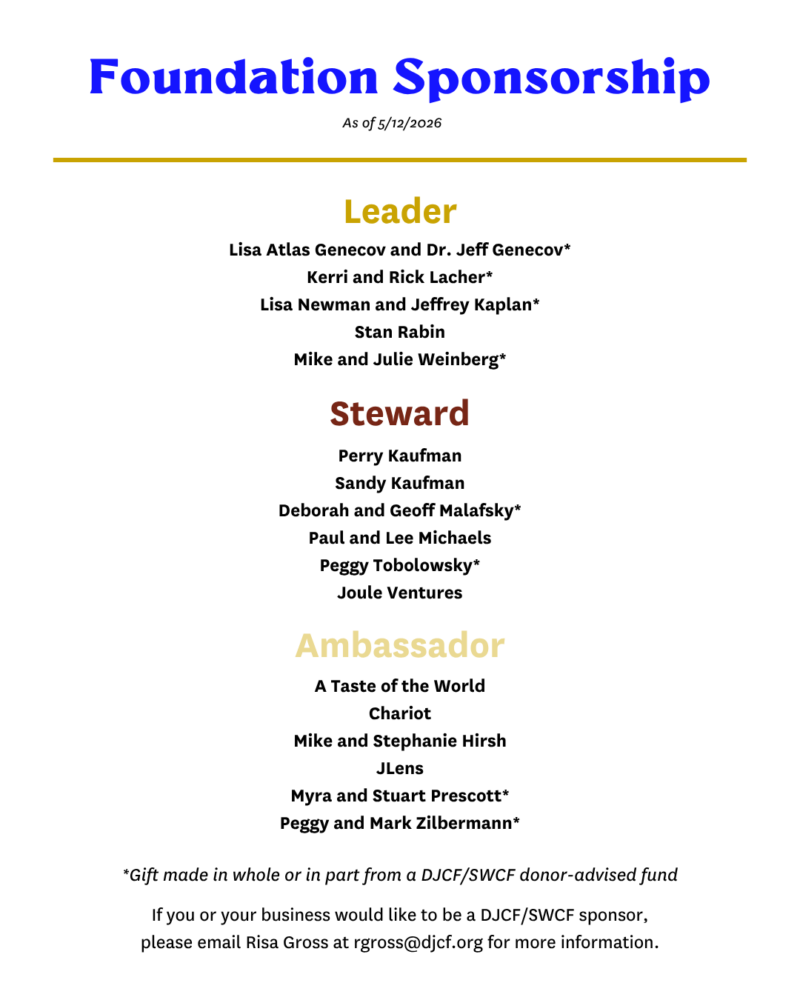
Foundation Sponsorships
If you’re interested in supporting our work or learning more about sponsorship opportunities, we’d love to hear from you. Please reach out to Risa Gross, Senior Director of Impact and Agency Relations, at [email protected] to explore ways to partner with DJCF/SWCF and make a meaningful impact in our community.
Scholarship Reception
Our recent Scholarship Reception brought together more than 250 attendees as we celebrated and honored 91 exceptional students. The energy only grew as attendees got to meet the students, while the students and their families showered gratitude to the scholarship fundholders and committee members that made their awards possible. Please click the buttons below to view photos (password: Dallas) and a digital version of the program.
Interested in establishing a scholarships? Contact us at (972) 645-1028 or email [email protected].
New Art
Our office is now adorned with beautiful new artwork, creating an inspiring and welcoming environment. Dr. Scott Peck, Director of The Museum of Biblical Art, has curated a museum-quality exhibition featuring works by local luminaries, including George Tobolowsky and Pamela Nelson—artists whose work has been showcased at the George W. Bush Presidential Library and NorthPark Center.
We invite you to stop by and experience the collection in person. Our office is open from 9:00 a.m. to 5:00 p.m., Monday through Thursday.
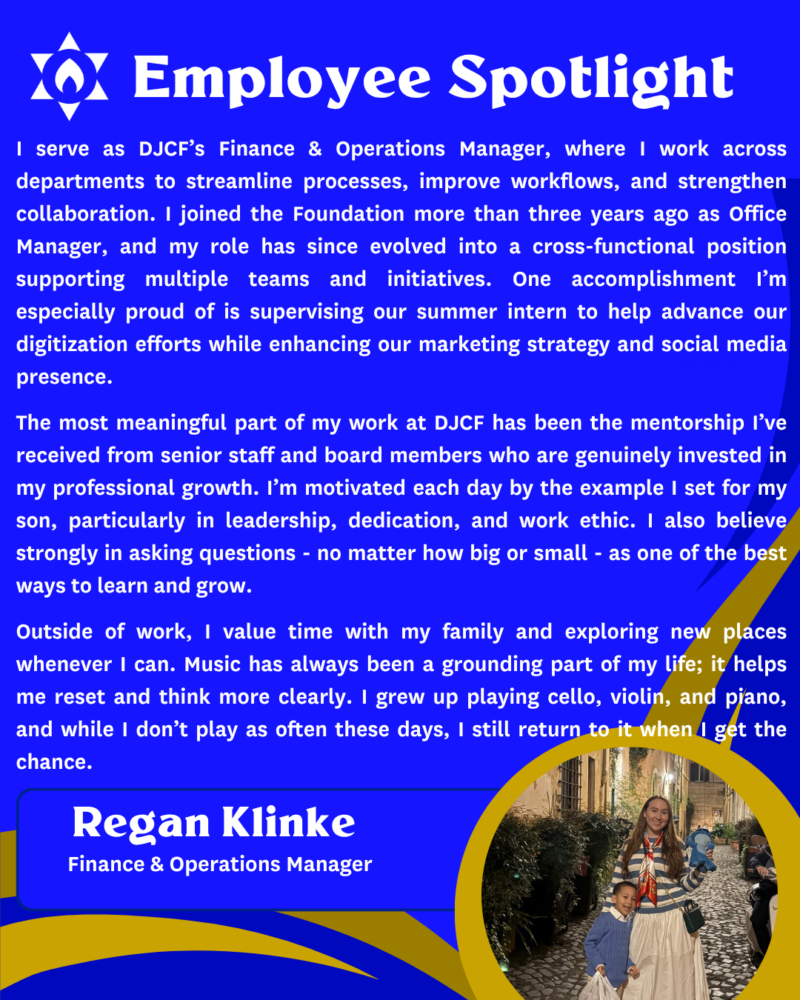
Employee Spotlight: Regan Klinke
Social Media
Follow us on social media to get the latest updates, stories, and a behind-the-scenes look at what we do. Join our growing community and be the first to know what’s new! Click on the links below to follow us.