
Relearning the Art of Joining
French political philosopher Alexis de Tocqueville famously observed in Democracy in America that Americans are people who constantly come together: “Americans of all ages, all conditions, and all dispositions forever form associations.” Put simply, America was a nation of joiners.
Nearly 200 years later, as we celebrate the 250th anniversary of the signing of the Declaration of Independence, we might ask: Is that still true?
One of the defining tensions of modern life is that we have become globally aware yet locally detached. Through our phones and screens, we are connected to events unfolding anywhere in the world, at any moment. Yet many of us know less about our neighbors, schools, congregations, and civic institutions than previous generations did.
This matters because authentic community requires more than awareness. It requires presence and responsibility. It requires showing up for one another.
In Hebrew, one word for community is edah, which can also mean “testimony.” Community is not merely a collection of individuals occupying the same space; it is a living witness to what people value together. Philosopher Martin Buber taught that true community emerges when two conditions exist: people are connected to something greater than themselves, and they relate to one another in ways that reflect that higher purpose.
Jewish tradition has long understood this truth. We are commanded not only to believe in shared values, but to embody them through action. Community is built through relationships, obligations, and acts of mutual care.
Technology has brought tremendous benefits, but when the internet becomes our primary community, it can distort our social instincts. We risk becoming spectators rather than participants, consumers of other people’s experiences rather than active contributors to our own. The constant exposure to global crises, tragedies, and outrage can leave us feeling anxious, helpless, and isolated, even as we become more “connected” than ever before.
Somewhere along the way, many of us traded the tangible rewards of joining, volunteering, gathering, and serving for the sterile convenience of scrolling.
President John F. Kennedy challenged Americans to ask not what their country could do for them, but what they could do for their country. While those words were spoken more than sixty years ago, they remain deeply relevant today. The antidote to disengagement is contribution. The cure for helplessness is participation.
Yet participation can feel overwhelming. The problems facing our world are enormous, and one person can understandably wonder whether their efforts matter.
Jewish wisdom offers a different perspective.
The Talmud teaches, “The poor of your own city take precedence over the poor of another city” (Bava Metzia 71a). This is not a rejection of global responsibility or concern for the broader Jewish people (Klal Yisrael). Rather, it reflects a profound understanding of human nature: we learn to care for humanity by caring for actual human beings. Compassion begins close to home.
When we disengage from local institutions, our synagogues, schools, food pantries, community centers, and neighborhood organizations, the social fabric that sustains us begins to weaken. Conversely, when we invest in those institutions, we strengthen the networks that support us during times of need and celebration alike.
I’ve been so moved recently by stories emerging from international visitors experiencing American life firsthand. Many describe being surprised by the friendliness, generosity, and everyday kindness they encounter. Their observations are a reminder that authentic human connection remains one of our greatest strengths. In a media environment often dominated by conflict and negativity, these simple interactions reveal something both hopeful and enduring: people still yearn for community.
The Jewish tradition calls this kehillah – a community built not merely on shared geography but on shared responsibility. The Torah teaches, Kol Yisrael arevim zeh bazeh, that each of us is responsible for one another. That responsibility begins not with grand gestures, but with small, consistent acts of engagement.
If we want to rebuild trust, belonging, and connection, where can we begin?
Three Ways to Strengthen Community
1. Give with Intention
Dedicate a portion of your charitable giving to local institutions that strengthen communal life—Jewish social services, Jewish day schools, community security initiatives, food assistance programs, and synagogues.
2. Show Up
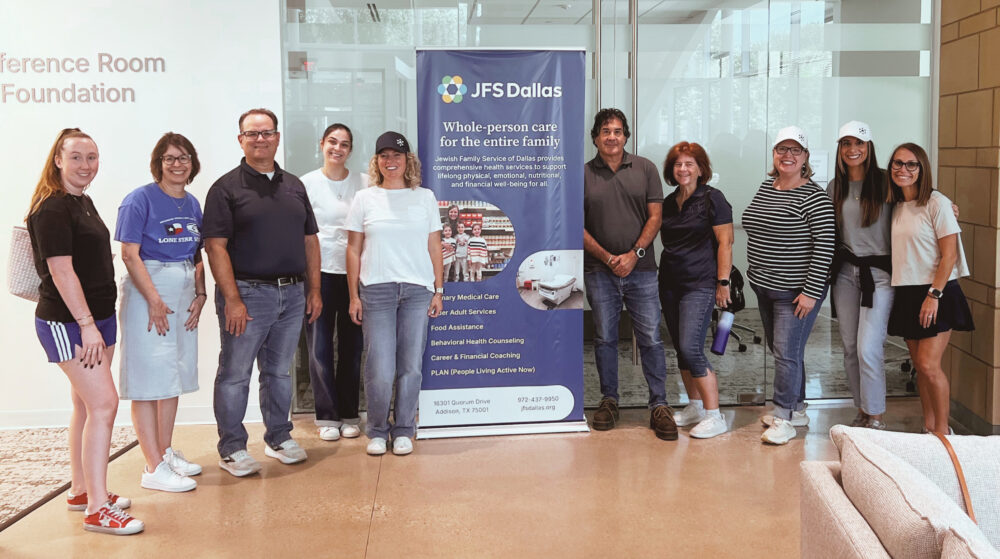
Attend a community event. Volunteer for a local organization. Join a study group. Introduce yourself to a neighbor. Relationships are built through presence, not proximity. A recent example shown below was our team volunteer day at Jewish Family Service of Dallas, where staff came together to support vital community programs while strengthening connections with one another.
3. Become a Builder
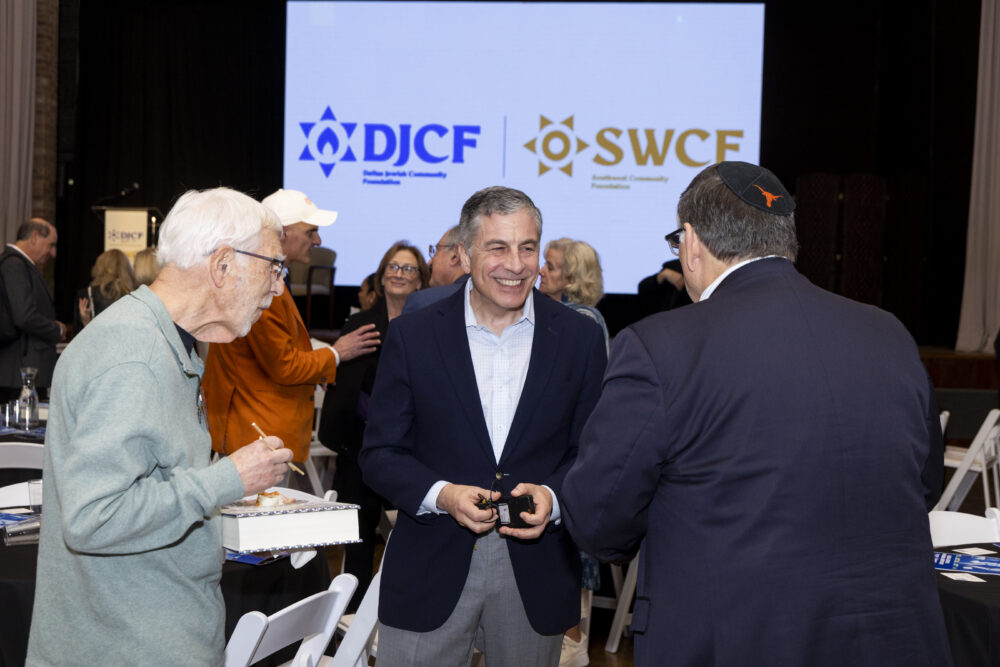
Serve on a board, committee, or volunteer leadership team. Communities thrive when people move from being observers to stakeholders. Below is a photo of Mike Weinberg, our Board Chair, at our 2025 Annual Meeting.
The sages teach in Pirkei Avot: “Do not separate yourself from the community.” That wisdom may be more relevant today than ever before. Authentic belonging is the antidote to modern isolation. We discover meaning not by attempting to solve every problem in the world from behind a screen, but by serving the people and places entrusted to our care.
My hope is that through acts of local engagement and shared responsibility, we help create the kind of community envisioned by the Psalmist: “How good and how pleasant it is when brothers and sisters dwell together in unity.”
– Psalm 133:1
DJCF Professionals Bring Deep Expertise to Strengthen Community Giving
DJCF’s commitment to professional excellence equips fundholders with expert, personalized philanthropic guidance. Through advanced certifications, specialized training, and multidisciplinary expertise in charitable planning, finance, and donor relations, the Foundation helps individuals and families turn their values into meaningful, lasting community impact.
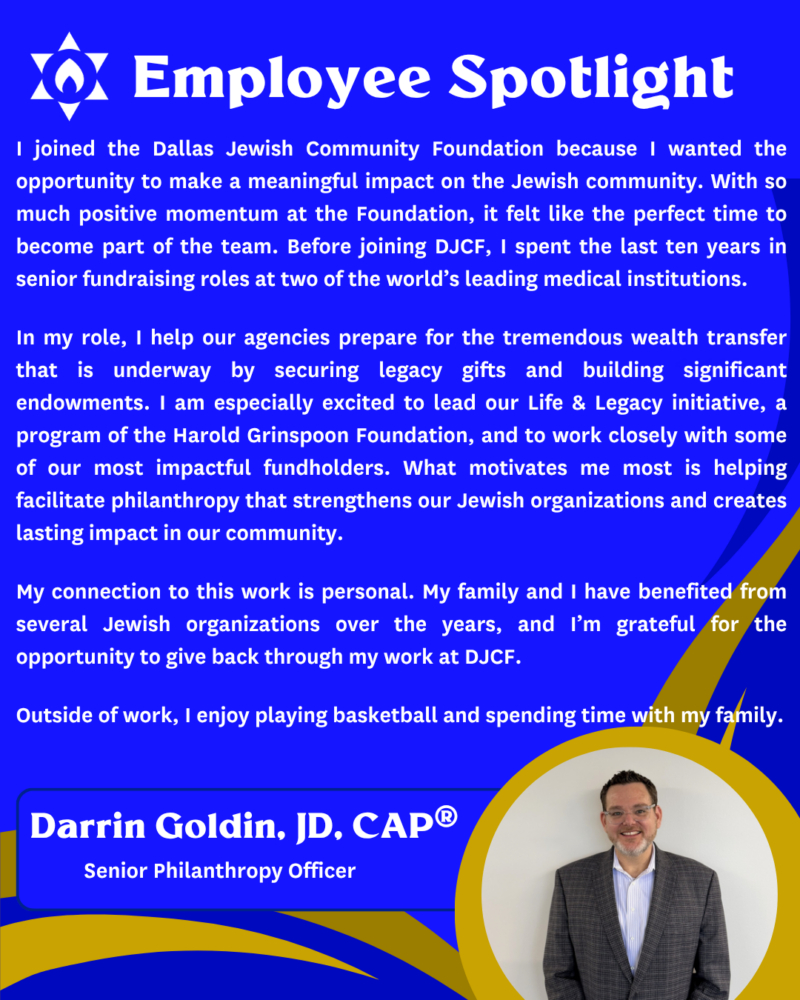
Employee Spotlight: Darrin Goldin
Philanthropy Insights: Involve the Next Generation
Summer is an excellent time to engage children and grandchildren in charitable discussions by inviting them to help identify causes that align with family values.
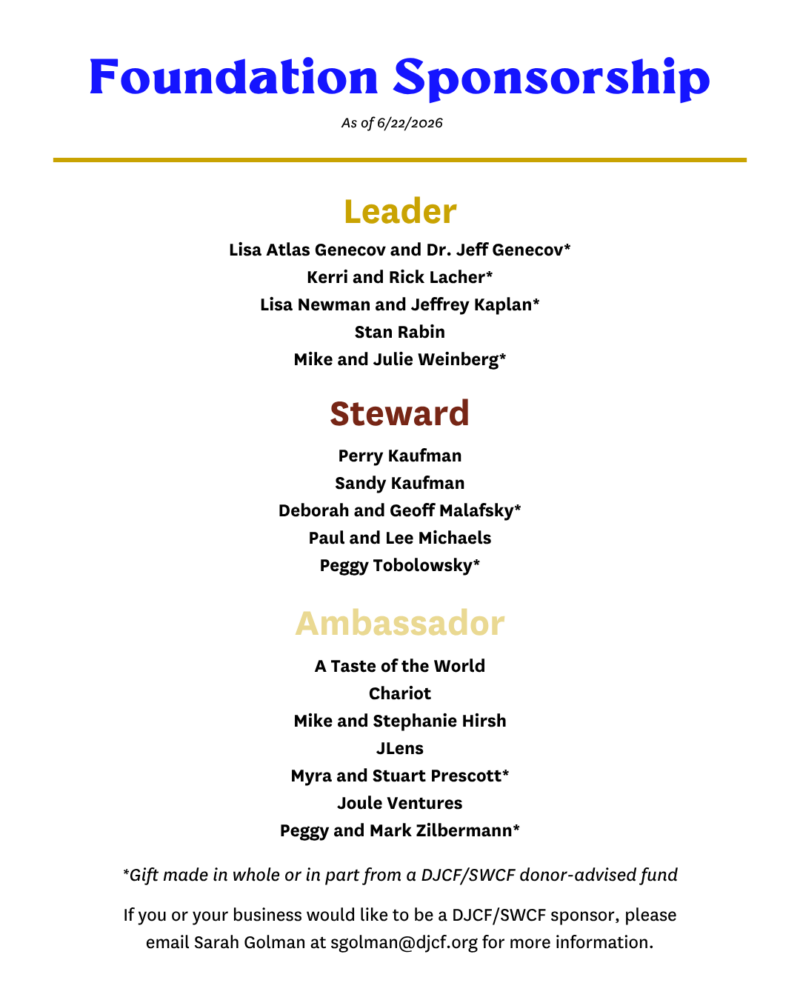
Foundation Sponsorships
We are deeply grateful to our sponsors for their generous support and commitment to the work of DJCF/SWCF. Their partnership enables us to strengthen our community and expand our impact. We are honored to foster a community of philanthropists who share our vision and values, and we thank them for helping make our mission possible.
If you’re interested in supporting our work or learning more about sponsorship opportunities, we’d love to hear from you. Please reach out to Sarah Golman, Chief Operating Officer, at [email protected] to explore ways to partner with DJCF/SWCF and make a meaningful impact in our community.
Social Media
Follow us on social media to get the latest updates, stories, and a behind-the-scenes look at what we do. Join our growing community and be the first to know what’s new! Click on the links below to follow us.